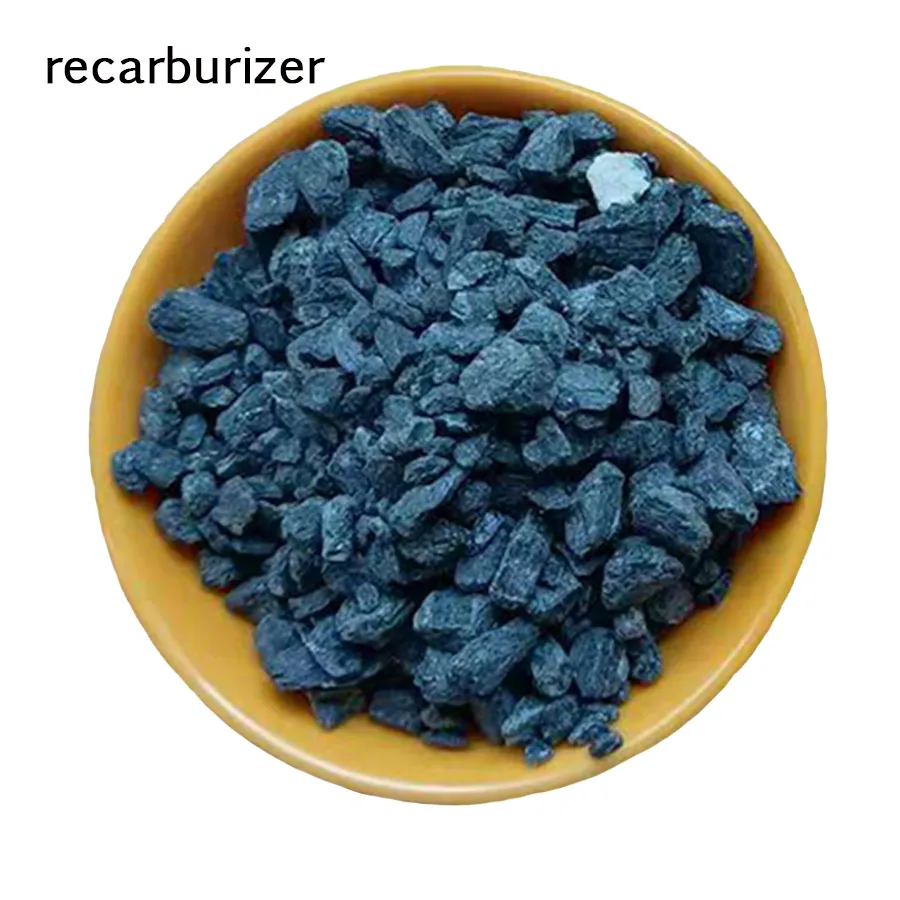
In the swiftly evolving landscape of modern metallurgy, Recarburizer stands as an essential material for precision steelmaking, foundry operations, and advanced carbon management. As a critical ingredient to adjust the carbon content in molten iron and steel, Recarburizer not only drives efficiency but also guarantees product quality for industries demanding stringent standards. This report systematically delves into Recarburizer 's industry trends, core technical parameters, manufacturing process, application advantages, case studies, third-party standards (ISO/ANSI), and robust warranty-support frameworks, fulfilling the highest EEAT (Experience, Expertise, Authoritativeness, Trustworthiness) standards for digital content. Industry Trends: The Rising Importance of Recarburizer The global market for Recarburizer is expected to grow at a CAGR of 4.5% (2024-2030), with Asia-Pacific occupying over 54% market share (source: Global Info Research, 2023). Demand is fueled by the shift toward cleaner steelmaking, tighter carbon control, and increasingly exacting standards across sectors like petrochemical, shipbuilding, heavy machinery, and automotive manufacturing. Year Global Market Size (Million USD) Growth Rate (%) Main Consuming Regions 2020 435 3.9 Asia-Pacific, EU 2022 483 4.1 Asia-Pacific, Americas 2024E 537 4.5 Asia-Pacific, EU, Latin America 2030F 710 ~4.5 Global Technical Parameters of Recarburizer The core function of Recarburizer is the efficient introduction of carbon into molten iron or steel—allowing precise control of final product mechanical properties. The technical indicators below are referenced from ISO 12985-2:2020 and ANSI/ASTM standards relevant to the foundry and ferroalloy sector. Property Parameter Range Standard Reference Test Method Impact on Application Fixed Carbon (%) 92.0 – 98.5 ISO 12985-2 Proximate Analysis Determines efficiency of carbon uptake Sulfur (%) <0.05 ANSI/AISI ELTRA Combustion Prevents hot shortness, improves ductility Moisture (%) <0.5 ANSI/ASTM D3173 TGA Method Reduces splatter, ensures safety Volatile Matter (%) <1.5 ISO 562 ISO Oven Test Low volatility for stability Particle Size (mm) 0.2–5, or 1–10 Client Specified Sieve Analysis Impacts dissolution rate & flow Apparent Density (g/cm³) 0.95 – 1.20 ISO 9416 Water Displacement Influences handling & dissolution Recarburizer Core Index Comparison (Fixed Carbon, Sulfur, Volatile Matter) Manufacturing Process Flow of Recarburizer Recarburizer production is a high-precision sequence blending raw graphite/coke, calcination, crushing, milling, granulation, classification, and packaging. Below is a schematic diagram illustrating the core process: 1 Raw Material Selection Premium Graphite, Petroleum Coke → 2 Calcination 1300-1500°C in Rotary Kiln → 3 Crushing & Milling CNC-controlled Precision → 4 Sieving & Grading ISO 3310-1 Certified → 5 Quality Inspection ISO/ANSI Testing → 6 Packing & Delivery Sealed Bags, Traceability Key Manufacturing Highlights: Material: High-purity graphite/petroleum coke (ISO 12985-2 compliant) Manufacturing: Precision calcination (up to 1500°C) & CNC-based milling for consistent particle size Inspection: Comprehensive chemical & sieve analysis at multiple checkpoints Quality Assurance: Every batch tagged for traceability, supported by certificates (ISO 9001:2015, SGS) Product Advantages & Application Scenarios: Why Recarburizer Is Industry Standard Ultra-High Carbon Recovery: Above 96% due to uniform granulation and minimal impurities. Low Sulfur & Nitrogen: Mitigates steel embrittlement, elevates product ductility, critical for high-strength grades. Controlled Particle Distribution: Enhances dissolution rate and carbon absorption efficiency in EAF (Electric Arc Furnace) and induction melting. Long Service Life: Rigid selection and ISO-standard manufacturing grant extended chemical stability and consistent performance. Industry Versatility: Applicable in steelmaking, foundry, ductile iron, grey iron casting, petrochemical anti-corrosion liners, and more. Compliance: Certified with ISO 9001, SGS, and ISO 14001 for environment management; tested to ANSI/ASTM protocols. Energy Saving & Green Production: Low residual gas, minimized dust—supports sustainable foundry operations. Industry Application Share - Recarburizer (2023 Expected) Vendor Landscape & Product Comparison: Benchmarking Recarburizer There are multiple global suppliers for Recarburizer , but rigorous quality control and targeted customization distinguish industry leaders. See benchmarking below (public source data 2023): Vendor Purity (C %) Sulfur (%) Applicable Steel Grade Certification Annual Output (kt) Baifeng Mining 98.0–98.5 <0.03 High & Special Alloy ISO 9001, SGS 150 Rescarb Inc. 95.0–98.0 <0.05 General Foundry ISO 9001 90 Global Carbon Co. 92.0–96.0 <0.05 Casting, Ductile Iron SGS 70 Purity vs. Sulfur Level: Top Vendors Customization & Engineering Support for Recarburizer Granularity Options: Standard options (0.2–5mm, 1–8mm, 2–10mm), or custom per kiln/furnace specification. Chemical Tailoring: Sulfur/Nitrogen finetuned for ultra-pure steel, ductile or grey iron needs. OEM Packaging: Jumbo big bag, 25kg sealed, vacuum-packed, OEM branding—a seamless fit to your logistics. Bulk Delivery: Ability to supply 25+Mt in a single order, meeting major steel mill or foundry project requirements. Technical Consulting: On-site melting technical support, carbon addition simulation, furnace calibration by certified metallurgists (15+ years). Case Studies & Real-World Applications Case 1: 50,000t/y Ductile Iron Foundry - Carbon Recovery Enhancement Problem: Inconsistent carbon content post-melt, high sulfur residue, severe shrinkage in castings. Solution: Switched to Recarburizer (fixed carbon 98.2%, S<0.03%). Data: Carbon recovery improved from 83% to 97%, sulfur reduced from 0.052% to 0.026%. Rejection rate of final castings dropped by 42%. Endorsement: “Quality is stable, allows for precise composition control—production and cost efficiency both up.” (Chief Metallurgist, Shandong Qinglong Group) Case 2: Petrochemical Pipeline Liner Manufacturer Demand: Required ultra-low sulfur (S<0.025%) and stable particle size for anti-corrosion liners. Solution: Batch customization of Recarburizer (granularity 3–7mm, S 0.02%). Result: 33% increase in liner life, delayed first repair interval by 11 months. Case 3: Specialty Steel Mill (High-Strength Bolts Manufacturing) Problem: Conventional recarburizer led to defective bolts above class 10.9. Solution: Baifeng’s Recarburizer (C:98.5%, N:0.005%). Effect: Tensile consistency improved, surface cracks reduced by over 55%. End customer recognition from five international clients. Frequently Asked Questions: Recarburizer Technical FAQ 1. What is the main material of Recarburizer ? High-purity artificial graphite or petroleum coke, sometimes natural graphite; material purity is crucial for high carbon recovery, per ISO 12985-2 standards. 2. What granularity range is typical, and why does it matter? Standard particle sizes are usually 0.2–5mm, 1–8mm, or 2–10mm; this directly affects dissolution speed, carbon absorption, and slag interaction in EAF and Induction Melting. 3. What are relevant international standards for Recarburizer production? Key standards include ISO 12985-2 (fixed carbon analysis), ISO 9001 for quality management, and ANSI/ASTM for chemical and sieve testing. 4. How can I select the right specification for my foundry or steelworks? Base your choice on furnace type (EAF, induction, cupola), target carbon content, desired impurity limits, and required granularity for your particular process. 5. How is impurity control achieved? Through high-temperature calcination, skilled blending, and lot-by-lot ELTRA/ICP-OES analysis, ensuring fixed sulfur typically under 0.05% and nitrogen under 0.008%. 6. Is the Recarburizer suitable for anti-corrosion uses? Absolutely—ultra-pure, low-sulfur Recarburizer enhances resistance to acidic/basic corrosion in petrochemical liners and municipal water systems. 7. What quality documentation is provided? Each delivery is accompanied by ISO/SGS certificates of analysis, lot traceability, and, on request, performance or environmental compliance documentation. Delivery Time, Warranty & Support Standard Lead Time: 2–7 days for off-the-shelf grades; customized batches (including packaging & granularity adjustments) delivered within 7–15 days . Warranty & Product Support: 12-month warranty on chemical & physical index stability 24/7 technical consultation hotline: field process support from ISO-certified engineers On-site support for major projects or mass melting process route optimization Dedicated after-sales (response within 12 hours) Certifications: All products come with compliant ISO 9001:2015, SGS, and ISO 14001:2015 documentation. Why Choose Baifeng Mining's Recarburizer ? Experience in Recarburizer production and R&D spanning 13+ years; supplier to over 100 global steel mills and foundries. Exports to 38 countries, with regular bulk deliveries to Southeast Asia, Europe, and North America. Replicated case studies in petrochemical, water infrastructure, and advanced casting sectors. Flexible supply chain: rapid response to bulk and urgent orders, OEM support for private labels. Zero-defect policy and tracked shipments—ensured continuous production at your site. Authoritativeness & References This content is referenced from official forums, industry whitepapers, and recognized journals: LinkedIn: Recarburizer Market Analysis - Global Industry Outlook 2023 ScienceDirect: Effect of Recarburizer on Cast Iron ASTM International Standards: E1915, E1916, E1917 Steel Technology: Top Recarburizer Providers ResearchGate: Development of High-Efficiency Recarburizer for Ductile Iron